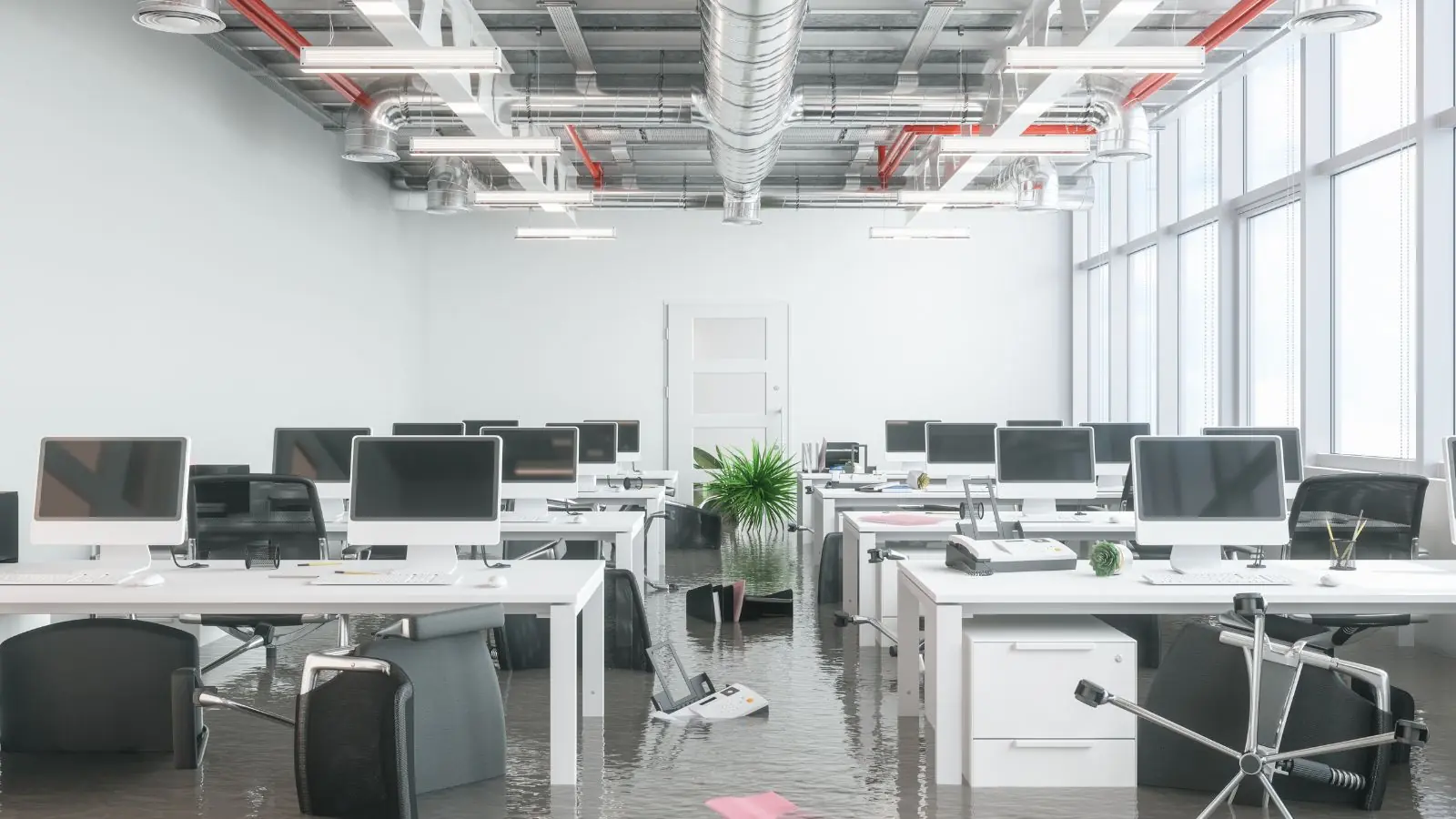
Commercial water damage: what the job involves
Commercial water damage is water loss in a building used for business, such as an office, warehouse, retail space or shared property. The causes match the home side, including supply line failures, roof leaks, sprinkler line breaks and drain backups. What changes is scale, because larger floor plates, longer wall runs and shared ceilings let water travel farther before anyone notices.
This page covers what we can do for a commercial loss: on-site assessment, water extraction, structural drying, cleanup coordination and documentation for your insurer. Scope and price are explained before work starts, and the 24/7 line is answered at all hours.
Why larger buildings in Santa Fe Springs need a different plan
Santa Fe Springs is a heavily industrial city beside older residential areas, so many commercial buildings here have large open floors, concrete slabs and storage areas. The city's draft Safety Element describes its commercial and industrial areas as part of the hazard picture, which tells a business owner that a building-wide plan matters more than a single room fix.
A leak over a warehouse bay can soak pallets, racking bases and a slab all at once. Water that runs under a wall into a neighboring suite becomes a shared problem, so call early and describe every space the water could have reached.
Water still spreading? The dispatch line is open 24 hours a day.
☎ Call (562) 271-5850
Tell us what is stored on site before work begins
The city's Fire-Rescue department serves as the Unified Program Agency for Santa Fe Springs, and the city's Environmental Protection Division says regulated businesses report stored materials through the California Environmental Reporting System. The Safety Element also notes that Fire-Rescue keeps detailed information on materials stored at businesses.
The practical meaning is simple. If your building holds chemicals, fuels, solvents or batteries, say so on the first call. Water can move or dilute these materials, and a crew needs to know what it is walking into before extraction or demolition starts. Tell us, and keep your hazardous materials list handy.
Signs of a commercial water loss
Commercial losses are not always a puddle in the lobby. Look for these clues in suites, storerooms and mechanical areas.
- ✓Ceiling tiles that sag or stain. Water is collecting above the grid, and the insulation and deck above may be wet too.
- ✓Floors that feel cool or slick near walls. Concrete slabs hold moisture, so a persistent damp edge points to a leak behind the wall.
- ✓Musty smell in closed storage rooms. Cardboard, drywall and carpet tile hold moisture and odor long after the leak stops.
- ✓Water meter running with the building empty. A moving meter overnight suggests an active line break, which needs a plumber.
- ✓Peeling paint or lifted flooring. Adhesives and finishes fail as moisture moves up through a slab or wall.
Safety first when water reaches power or storage
If water has reached an electrical panel, a motor, a light fixture or a lift charger, stay out of that area. Cut power only if the panel can be reached dry, and call the utility or 911 for electrical or gas risk before you call the restoration line. Keep staff and visitors out of any room with water near energized equipment.
Floor drains that back up or water that smells like sewage must be treated as contaminated, and no fans should run until the water is known to be clean. For that situation, read about sewage backup cleanup before anyone enters the space.
How we handle a commercial loss
The sequence is the same logic as a home loss, scaled to the building.
- 1Assess with instruments. Moisture meters and thermal imaging cameras trace water through walls, ceilings and slabs so the scope is based on readings.
- 2Extract standing water. Truck-mounted units and submersible pumps move large volumes, and wet vacuums finish edges and corners.
- 3Dry the structure. Air movers and LGR dehumidifiers run until readings match dry reference materials. The method follows the published standard ANSI/IICRC S500.
- 4Coordinate cleanup. Removal of wet materials, containment barriers and HEPA air scrubbers keep dust and debris from reaching occupied areas.
- 5Document the work. Photos, moisture logs and scope notes give your insurer a clear record.
Drying a large slab and wall system is covered in more detail on the structural drying page, and it applies to commercial rooms as much as to homes.
Staying open or closing: the trade-offs
Business owners often ask whether they can stay open during drying. The honest answer depends on the loss.
| Situation | Can the space stay in use? | What to weigh |
|---|---|---|
| Small clean-water leak in one room | Often yes, with that room closed | Equipment noise and cords in walkways |
| Water across a main floor | Usually no during extraction | Slip risk and wet electrical gear |
| Sewage or drain backup | No, until cleaned and cleared | Contaminated materials and the need for containment |
| Ceiling collapse or heavy leak above | No in the affected zone | Falling material and a wet deck above |
Occupancy decisions also depend on your landlord, lease and local rules. Ask the city Building and Safety Division if a reopening needs inspection.
Commercial insurance and what is excluded
The California Department of Insurance states that homeowners and commercial policies typically exclude flood, so rising ground water or storm flooding may not be covered under a standard business policy. Sudden pipe failures are often treated differently from gradual leaks, which are frequently excluded.
Read your policy, ask your insurer about business interruption and keep every invoice, photo and moisture log. We do not promise approval or a payout, only a clear written record of the work.
What drives commercial water damage cost
Commercial pricing is set by the loss, not by a rate card. These factors decide it.
- ✓Water category, with sewage and drain backups needing more handling
- ✓Affected area, including floors, walls, ceilings and shared spaces
- ✓Materials such as concrete, carpet tile, drywall, insulation and stock
- ✓Drying days and the amount of equipment needed in a large open space
- ✓Rebuild scope after drying, which is often a separate trade
Want your real number? Call and describe the loss, and the scope and price are explained before work starts.
Mistakes to avoid after a commercial leak
A few habits cost businesses extra days.
- ✓Waiting for the property manager before shutting the water off
- ✓Moving stock into damp storage rooms and spreading moisture
- ✓Running building fans in a space with possible sewage
- ✓Discarding wet materials before photos and an inventory are taken
- ✓Skipping neighboring suites, where water often travels under shared walls
Local help for businesses near Santa Fe Springs
Santa Fe Springs Water Damage Pros is licensed and insured, and the scope and price are explained before work starts. We serve Santa Fe Springs and nearby towns, including Norwalk, Downey, Whittier, La Mirada and Pico Rivera. A business on the Norwalk side can read the Norwalk service area page.
When the water is already on the floor, emergency water removal is the first step, then drying and cleanup follow.
Frequently asked questions
Yes. Calls are answered at night, on weekends and on holidays. Crews are dispatched the same day when available, and no arrival time is promised.
Yes, on the first call. The city's Fire-Rescue department tracks stored materials at businesses through state reporting, and water can move or dilute them. Knowing what is on site lets the crew plan extraction and demolition safely.
Scheduling is discussed on the call, and the dispatcher explains what can be done after hours. Large losses often need continuous work, while small ones can be staged around operations.
Photos, moisture readings and a written scope of what was removed and dried. These are records of the work, and approval of a claim remains between you and your insurer.
Usually not. The California Department of Insurance says homeowners and commercial policies typically exclude flood, and NFIP coverage is sold separately. Check your policy or ask your insurer, because a burst pipe and a storm flood are treated differently.
Sometimes, when the loss is confined to one clean-water room. Water across a main floor, sewage or an electrical risk usually means closing that area until readings are dry and the hazards are cleared.